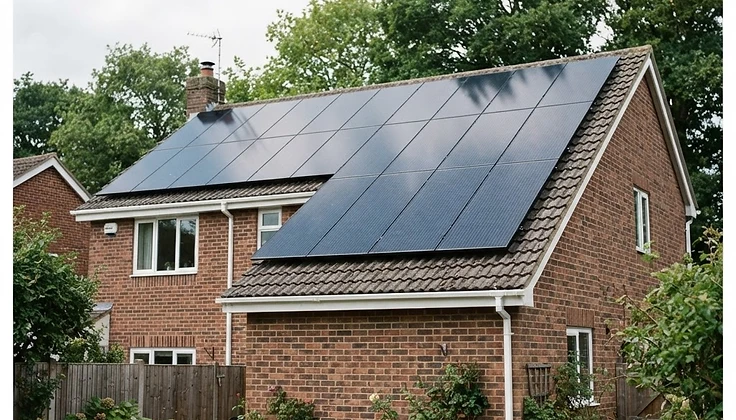
Household arrays and what they collect
A typical domestic array sits on one or two roof slopes and is left alone for years at a time. Rain deals with a fair proportion of loose dust and pollen, which is why many panels look reasonable without any intervention. What rain handles poorly is anything sticky, dried or rooted: bird mess that has baked on through a dry spell, sap and leaf residue from an overhanging tree, moss creeping in from a nearby tile or gutter, and the fine greasy film that builds up on homes close to busier roads.
The pattern of soiling on a house roof is rarely even. Contamination gathers along the bottom edge of each panel where water sits before it drains, and it concentrates wherever birds perch on a ridge, an aerial or a chimney directly above the array. Two identical houses on the same street can end up in very different condition simply because one has a mature tree behind it.
Visible dirt against actual performance
It is worth being clear about this before anyone books a visit. Visible dirt does not automatically mean the system is underperforming. Cleaning removes surface contamination, and whether that produces a noticeable generation difference depends on how dirty the panels were and the wider condition of the system.
If your readings have fallen and the glass looks broadly clean from the ground, the cause may sit inside the system rather than on top of it. Inverter faults, a tripped isolator, a failed string or cabling problems all show up as reduced output and none of them are solved by washing the panels. That is covered in more detail on the solar panel maintenance page.
Access, roof height and pitch
Access decides both the method and the price. A water-fed pole system with purified water can reach a great many two-storey roofs from the ground, which keeps the work simple and avoids anyone being on the roof at all. Bungalows and garage-mounted arrays are usually straightforward. Three-storey townhouses, steeply pitched roofs and deep arrays that sit well up the slope may be beyond safe ground-level reach.
Conservatories, single-storey extensions, porches and awnings under the panels also change the approach, because there is less room to place equipment and less scope to stand back from the elevation. Shallow-pitched arrays are a particular case: they hold water and contamination for longer, so they often look worse, while also being harder to see from ground level.
Please do not climb onto a roof to inspect or clean your own panels. A photograph taken from the garden or the pavement gives us what we need, and roof access is not something a homeowner should attempt.
How the clean is carried out
The aim is to lift contamination off the glass without treating the panel surface harshly. That means purified water, soft brush heads suited to panel glass, and no abrasive pads or aggressive chemical treatments. Panel frames and the immediate area around them are dealt with where they can be reached safely, since organic growth at the frame edge tends to be the part that returns quickest.
Heavily soiled sections take longer than the rest of an array and are handled separately rather than being rushed. Where a stubborn deposit will not come away without risking the surface, it is better to say so than to keep working at it.
When cleaning may not be required
There are properties where the honest recommendation is to leave it. An exposed array on a good pitch, with no trees nearby, no roosting birds and no visible staining, is often doing perfectly well on rainfall alone. In that case a clean is an expense without a clear purpose, and it is better to check again in a year.
Milton Keynes homes cover a wide range of situations, from established estates around Bletchley and Wolverton to newer developments at Whitehouse, Fairfields and Brooklands. Describe what you can see, roughly how many panels you have and the postcode, and you will get a straight answer about whether the work is worth arranging.