Why droppings behave differently to dust
General dust and pollen form a thin, even film that rain shifts reasonably well. Droppings are thick, they dry hard in warm weather and they bond to glass. Once baked on through a dry spell, rainfall makes very little impression on them.
The placement matters too. A dropping that covers part of a cell blocks light on that specific area rather than dimming the whole panel evenly. Where mess is spread across several panels along a run, that localised effect is the reason people notice it. Even so, cleaning removes surface contamination and the generation difference afterwards depends on how heavily soiled the panels were and on the wider condition of the system.
Where the mess usually comes from
Perching positions above the array are the usual source: a roof ridge, a chimney stack, a television aerial, a satellite dish, a tall tree behind the house or a nearby lamp column. Around Milton Keynes, properties backing onto woodland, linear parks, balancing lakes and the more mature tree cover in areas such as Loughton, Great Linford and the older parts of Wolverton and Stony Stratford see more of it than open, exposed plots.
Nesting under the array is another pattern worth knowing about. The gap between the panels and the tiles is attractive to birds, and where nesting is active you may see repeated soiling, debris on the tiles below and material poking out from the panel edges.
Assessing it from ground level
Assessment starts from the ground or, ideally, from a photograph you take from the garden or pavement. What we are looking for is how many panels are affected, whether the mess is fresh or dried on, whether it sits at the top or bottom of the array, and whether there is any sign of nesting activity beneath the panels.
Please do not climb onto the roof to look. A wide photograph of the whole roof plus one closer shot of the worst area is enough to judge the job, and it keeps you safely on the ground where you belong.
How heavy soiling is cleaned
Heavily soiled areas need dwell time rather than force. Purified water and a soft brush head suited to panel glass will lift most deposits once they have been properly wetted and given a chance to soften. Repeated passes over a stubborn patch are safer for the panel surface than scraping or abrasive pads, which have no place on solar glass.
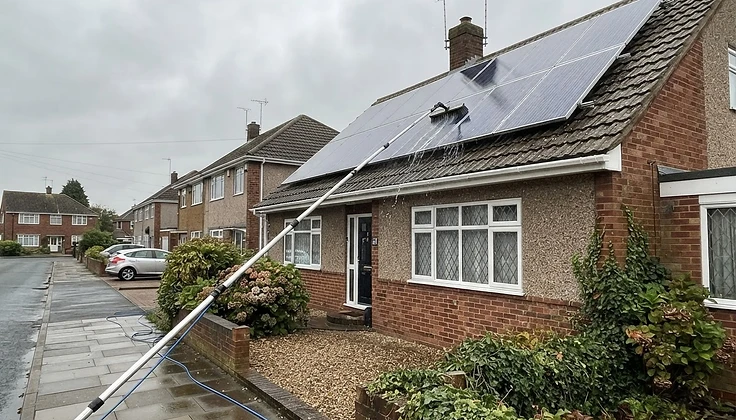
Where the array can be reached from the ground, a water-fed pole system usually handles the work. Higher or deeper arrays may need suitable access equipment. Occasionally a deposit will not come away without risk to the panel surface, and in that case you will be told rather than have the surface worked at regardless.
Repeated soiling and what to do about it
If mess returns quickly in the same spots, that is site behaviour rather than bad luck, and it is worth planning around. Some owners choose a scheduled clean at a sensible interval. Others prefer to wait until soiling is genuinely visible before arranging anything, which is a perfectly reasonable approach.
Bird-proofing exists, and mesh or clip systems around the panel perimeter are sometimes appropriate, but it is not recommended by default here. It adds cost, it needs to be installed carefully so it does not affect ventilation or the mounting, and where nesting is active there are welfare and legal considerations around timing. The honest position is to look at your specific array and the pattern of soiling first, then decide whether it is warranted at all.