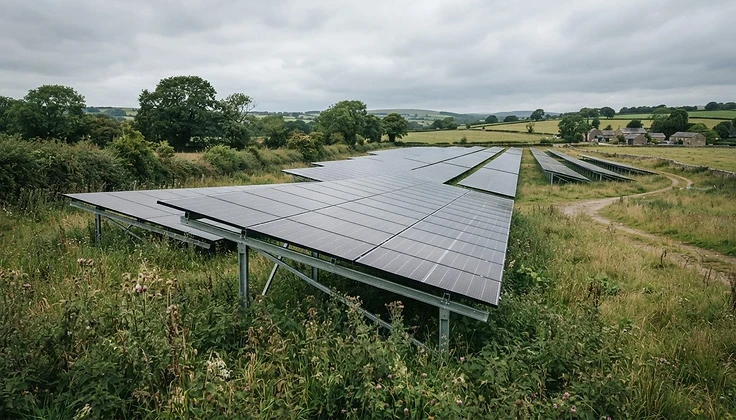
Access is simpler and safer
The obvious advantage is height. Nobody needs to work at roof level, ladders and elevating platforms are rarely part of the job, and the whole array can normally be reached on foot. That makes the work safer, more thorough and easier to plan, because every panel can be seen properly before and after cleaning.
It also means the panel surface can be inspected closely while the clean is carried out, which is much harder on a two-storey roof. Cracked glass, a module sitting out of alignment, damaged cable clips or vegetation growing into the frame are all easy to spot and can be reported back to you.
Larger arrays and how they are quoted
Ground-mounted installations tend to be bigger than domestic roof arrays, sometimes considerably so. Field-scale arrays on farms, rural business sites and commercial premises can run into hundreds of panels laid out in long rows.
Quoting therefore leans on panel count, row layout, the terrain around the frames and the water supply available on site, rather than on roof height and pitch. Ground conditions matter: soft or rutted ground in wet weather affects how easily equipment moves along the rows and how long the work takes.
Soil splash and the lower panel edge
The characteristic soiling pattern on a ground-mounted array is at the bottom. Rain splashes soil and grit up from the ground onto the lowest few inches of glass, and because that band is where water drains and sits, deposits build up and dry there repeatedly. Grass clippings from mowing around the frames add to it.
That lower band matters more than its size suggests, because it runs across the full width of the panel. It also tends to be the part that ordinary rainfall never clears, so it is the part that usually needs attention even when the rest of the array looks acceptable.
Vegetation and organic debris
Grass, nettles, brambles and self-seeded shrubs grow towards the light and, on an array that has not been maintained for a while, they will reach the lower rows. Growth that touches the panels causes shading, holds moisture against the glass and frame, and encourages moss and algae along the frame edge.
Cleaning the panels is straightforward; keeping vegetation off them is a separate ongoing task for the site. Where growth is already interfering with the array, clearing it back before or alongside the clean makes the work far more effective. Where nesting or wildlife is present around the frames, that needs to be taken into account before anything is disturbed.
Rural and commercial sites around Milton Keynes
Ground-mounted arrays around Milton Keynes are typically attached to farms, equestrian and rural business properties, and commercial premises with land available beside the building. Sites near open farmland pick up seasonal agricultural dust and residue, while those beside yards and access tracks tend to see more general grit and splash.
As with any array, cleaning removes surface contamination and the resulting generation difference depends on how soiled the panels were and the wider condition of the system. If output has dropped and the glass is broadly clean, the issue is more likely to sit with the inverter, the strings or the cabling, and that is work for a qualified solar technician. Tell us the location, the approximate panel count, the row layout and the ground conditions, and you will get a realistic quote.