The property types this covers
Work of this kind typically involves warehouses and distribution units, light industrial premises, office buildings, retail units, schools and community buildings, and ground-mounted arrays attached to a commercial site. Milton Keynes has concentrations of exactly this sort of building: the business areas at Knowlhill and Linford Wood, the industrial and office mix at Kents Hill and Tongwell, Caldecotte, the logistics footprint around Magna Park and the M1 corridor, and the office stock in Central Milton Keynes.
Those locations are named because they describe the kind of buildings served, not to imply completed contracts at any of them. There is no branch office in each area and no client list published here.
Larger arrays change the work
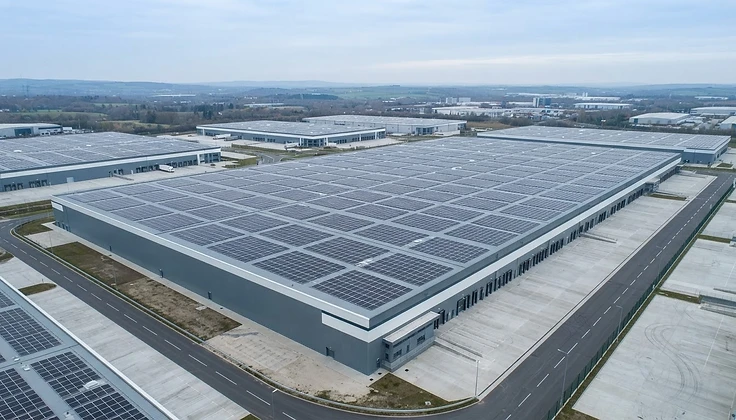
A commercial array can run to hundreds of panels across a single roof plane. Cleaning it is a planned operation rather than a short visit, and the scope needs to be agreed in advance: whether the full array is being cleaned or a defined section, how the roof is reached, and how long the team will be on site.
On a broad flat or low-pitched commercial roof, contamination behaves differently to a domestic slope. Water drains slowly, so general grime spreads more evenly across the array and settles along the lower edge of each module. Roofs downwind of yard traffic, loading operations or nearby construction tend to accumulate a heavier film than an exposed roof in open ground.
Access planning and safe working
Access is usually the deciding factor in a commercial quote. Some arrays can be reached from the ground with extended pole systems. Others need mobile elevating work platforms, tower scaffold or documented roof access using the building's own fixed anchor and walkway provision, which we would need details of from the building owner or managing agent.
Safe working arrangements are agreed before the visit: how equipment gets in, which areas need to be cordoned, whether a permit to work is required, what site induction applies, and who signs off on the arrangements. If a roof cannot be worked on safely with the access available, the right answer is to arrange suitable equipment or not to proceed.
Working around an operating site
Very few commercial buildings can stop for a cleaning visit. Yard movements, deliveries, shift patterns, school hours and customer access all shape the timing, so work is often scheduled early, late, at weekends or during holiday closures. Facilities managers usually want a single point of contact, a fixed window and a clear method for the work, and that is how it is set up.
Where an array is large or the site is sensitive, cleaning can be phased across visits rather than attempting the whole roof at once. That keeps disruption predictable and lets you spread the cost across a budget period.
Scheduled cleaning and how quotes are built
Some commercial sites benefit from a planned schedule, particularly where a roof sits under trees, close to bird activity, or beside a busy service yard. Others do not need it. Frequency should follow the observed rate of soiling on the specific roof rather than a figure applied to every building.
Quotations are based on the number of panels, the array layout, roof height and pitch, the degree of soiling, the access method required and any site-specific safety requirements. Drone or roof photographs, a panel schedule from the original installation or a site plan speed this up considerably. If you tell us the site, the approximate panel count and how the roof is currently reached, you will get a realistic figure and an honest view of whether the clean is worth doing now.